Thursday, April 12, 2012

Wooden Owls


I have been working on a series of wooden owls lately, mostly outside. In my back yard I have a picnic table, where I carve wood and make other objects. My interest in wood carving started several years ago, when I learned how to carve woodcut relief for printmaking. A couple of years ago, while visiting a friend in Northern California, I was introduced to chainsaw carving on redwood. I was given a large stump that later morphed into an owl. Nowadays, I don't use any mechanical devices for the sculptures, everything such as carving, sanding, filing, and sawing is done with non-electric hand tools.
When I visit Alki Beach or am driving around town I look for wood that I can use for the task. I use whatever is available, as long as it doesn't appear to be treated chemically, or is rotted through. Mostly I pick up rounded stumps, old 4X4's or 4x6's, and also I have used boughs and branches from trees in my yard.
To start, I use a hatchet to cut of the bark, remove rotten parts, or to round off the edges. Then I use a wide u-gouge to make indentations for the carving of the head and feet. Details are done with a v-gouge. I use a large u-shaped gouge with a mallet for the eyes. The wood chips and shavings are used as mulch for my garden.

To finish, I use wood files and sandpaper. I like the way the wood grain appears after this process. In older woods, especially pine, the sap seeps through to add a waxy polish. Lately, I have also used pumice sand and foam in place of the sandpaper. The pumice, is left from a boulder I am carving. Eventually I will have a series of stone owls too. Some of these owls I will leave unfinished, or perhaps add a light application of linseed oil.


On other owls, I like to use inks as a stain application. I use sumi and walnut inks to make details. I like how the ink soaks into the wood and bleeds a bit, similar to using oxides on bisque clay bodies.
I painted some of the owls with a combination of acrylic paint and inks. These tend to look more like my glazed ceramic owls.

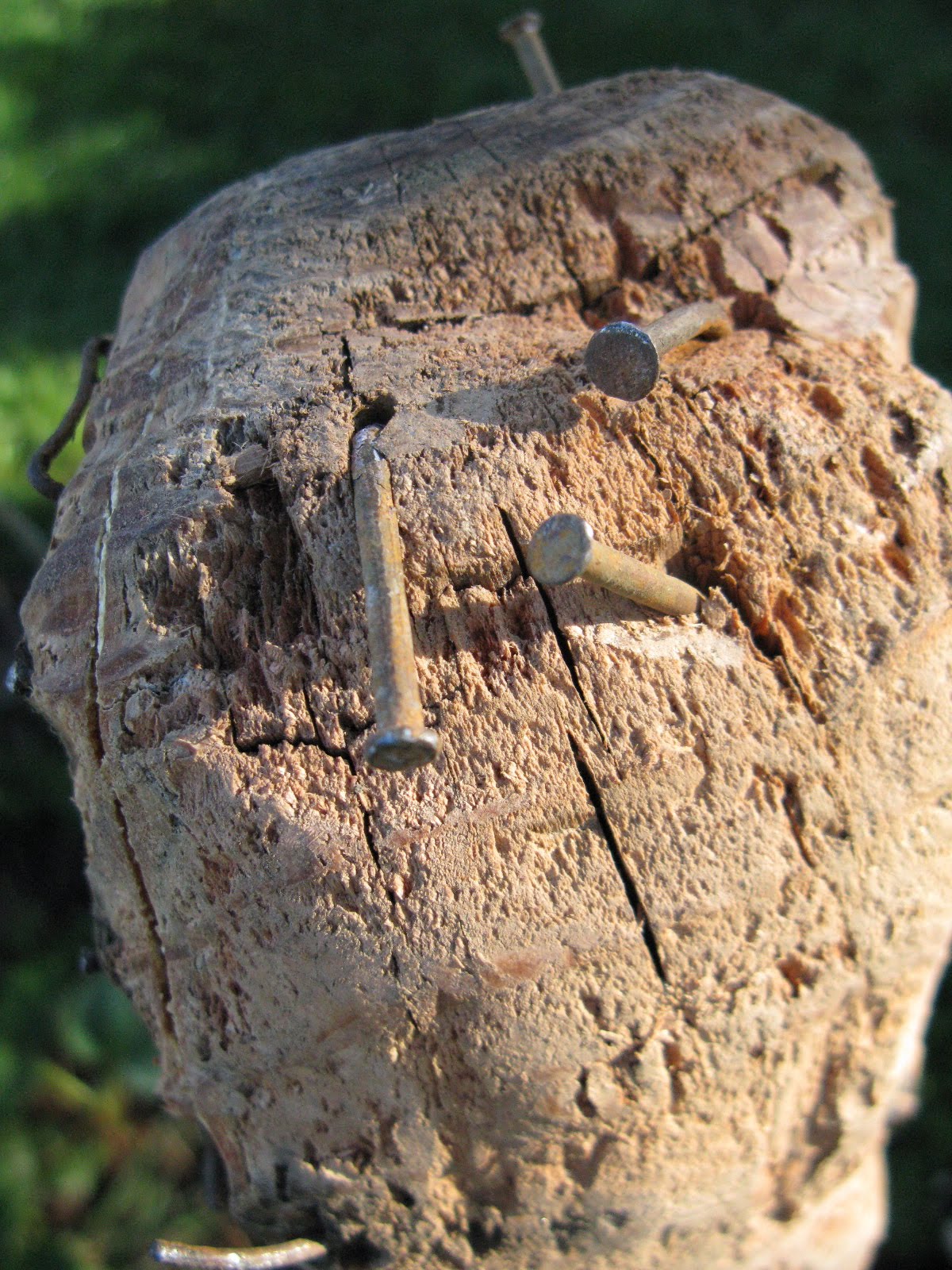
One piece of wood I acquired, had old nails sticking out of it. I carved around some of the nails, and took some out while carving. When I was finished, I put the ones I had taken out back in their place. I also hammered in a couple of more and added eyes made out of old Washington State tax tokens. My grandfather, Pete Murray had found the tokens while working at the old Navy homes, in Pasco, Washington.

Finally, I decided to use some aluminum metal sheeting to make an armored owl

Saturday, March 10, 2012

Cascadia Now! at Fancy


This month features Cascadia Now! at Fancy. Fancy's owner and fellow UNT (North Texas) alumni Sally Brock allowed me to curate an exhibition of art for the NCECA conference. NCECA is an annual ceramics extravaganza held each year at a different location around the USA. This year the conference is in Seattle and it's theme is "On the Edge". The National Council for the Education of Ceramic Arts hosts numerous exhibitions, informational sessions, art shows, and lectures by artists from around the world. It is THE place to meet, and learn from other ceramic artists and educators. So this month I was able to put together a small show of regional artists from CASCADIA.
My original idea for Cascadia Now! was to make a show of regional artists with their own interpretation of what a Cascadia could look like. Cascadia, according to most interpretations is mainly the northwest corner of the US and part of Canada which includes Northern California, Oregon, Washington, British Columbia, and may or may not include parts of Montana, Idaho, Alaska, and the Queen Charlotte Islands. The book Ecotopia talked about a Cascadia,many separatists,environmentalists,small government advocates,websites,blogs, and even wikipedia have written about it.
I was thinking about the original thirteen colonies and how less than 5 million formed what became the USA and thought that if our country ever fell apart, we could re-form a nation here in this region, because Washington State alone has 8 million people and the people north and south of us generally are similar in culture, appearance, and politic. Who knows if it will ever happen, certainly I hope not, because I do love the USA. For this show I thought a lot about souvenirs so I created Cascadia lighters from porcelain and other light bodied clays.


I also created some functional ceramic banks. These are in reference to the current upheaval surrounding WALL ST and the movement of the 99%ers. I made a Bank of America, Chase Bank, and a Citibank. By the way, although the images are striking, I DO NOT ADVOCATE setting things on fire, because of the danger it poses to WORKERS, who are just innocent people trying to make a living. I made these banks with the hope that people may find ways to save money by keeping it at home stored safely inside a sculpture.

Seattle artist Charles Krafft created a convincingly real-looking plate with an open switchblade knife and drips of red stain that looks like fresh blood. On the plate is a flag and a insignia for the Northwest Volunteer Army. Charles is known for his china painted sculptures, disaster ware plates, and his link to the Northwest Mystic painters.

Chris Theiss and Kristen Loffer Theiss are an artist couple that reside in Skagit County. For the Cascadia theme, Chris made a interesting slab built construction of a table, 2 chairs, a bowl of fruit, with a hanging chandelier above. The work itself functions as a vase. Chris uses a sgraffito method to etch detailed images into his forms. Kristen, a needlework artist, made fine detailed embroideries of iconic northwest creatures. Among them: a squirrel, an owl, and a small wren.


Matthew Cox, of Ellensburg made cans cast from liquid clay(slip). He then took the pieces in a leather hard state, where he shot them full of holes with a rifle. The playful execution of the work, evokes images of the old west, where gunfighters and cowboys ruled the land. Matt also made some beer bottles, otherwise known as "stubbies", out of wood and even included them in an old cardboard Rheinlander Beer case.

Zoe Garred, a designer and artist from Portland, made functional lamps that resemble styrofoam floats in both shape and color. These float lamps are reminiscent of many floats found around the sea-side port towns that dot the Northwest Pacific coast. The works are well crafted and pleasantly designed.


Claire Cowie, for this show created numerous bear sculptures out of resin (see top). The sculptures themselves resemble porcelain, and the only way to tell that they are not is by picking them up. The bears are in various upright poses, lack definitive body parts, but have fine details painted on the surface. The details include various colors, suggested texture, attributes, and various phrases. There seems to be some sadness evoked in the bears expressions, the eyes especially; however the words chosen seem to yearn for a bright future and "harmony between the seen and unseen worlds"

Garth Johnson of Arcata, CA and extremecraft.com made an incredible urn. It depicts a sasquatch -like creature walking through a stand of tall trees (redwoods?).The title of the piece implies that perhaps this is a souvenir from Cascadia. The urn has characteristics similar to Victorian era porcelain, the kind often seen in museums and antique shops. It features use of decals, overglazes, and lusters in coloring and detail. Garth is also speaking at the NCECA conference on Friday.

Jeffry Mitchell, a Seattle ceramist and sculptor, made a terrific sculpture for this exhibition. It has a bear riding on top of another bears shoulders standing on a landscape, with a bough of a tree standing next and bare ground underneath. The entire sculpture is glazed in a semi-opaque brown glaze. Various stains of green and blue appear as accents. The bears speak of love between men.


Kate Greiner (Murray) made a quilt for the show. Quilting, like ceramics is a process orientated art, that can be either functional or decorative. Kate used over 300 triangles out of dozens of fabrics to create a picturesque landscape of Cascadia. There are mountains, trees, a sea, and a bright sunny sky. Though originally a painter, she is making a seamless transition into quilting, and much like her paintings these quilts reflect on visions of a colorful and varied textured world.

All of these artists came up with something that they felt fit the theme of "Cascadia Now!". Sally Brock was instrumental in finding many of the artists for the show, and with her hosting, I give many sincere thanks.
The Closing Reception for Cascadia NOw! is Friday, March 30th from 6 to 9 PM. It is at Fancy. Fancy is located at 1914 2nd Avenue in Seattle. www.fancyjewels.com

Thursday, February 2, 2012

New works finished


Here are the sculptures I recently finished. They were built by coiling and pinching techniques made from low-fire earthenware clay. I decorated them with under glazes and stains. Pegasusunicorn giraffe detail.
Pegasusunicorn giraffe or pegiracorn.
Hippocats

Friday, January 27, 2012

Today in Kirkland I taught two great classes. This is not to brag. In fact , the only reason the classes were so much fun was because of the people in them.
At 4 till 6:30 PM is my Wheel World class. In this class we just explore clay. The ages generally range from 9 to 16. Of course, the focus is the wheel, but overall I am most intrigued by getting my students to understand the nature of clay as a way to learn about themselves and what they really want to know about this world. This might sound really wild --and it is! That is because a piece of clay has infinite possibilities and if we are able to strive for certain possibilities within the clay then we may use that as a metaphor for shaping our own lives. Lives with infinite possibilities shaped by the mind that controls the hands. So today's class was great. A pair of best friends returned to make Fairy houses and mushroom pads, 3 girls learned how to center their first pots on their own , and a boy of 10 learned the difficulty of working on the wheel and eventually found the sculptural tools, particularly the slab roller , a little more satisfying.
From 7 to 10 is my clay 101 class. It is an adult class, though in this session I have 5 people who are under 20. So today we explored the sculptural techniques of pinching and coiling. For the pinch projects I started off with a simple pinch pot, and talked about the importance of a foot. I added textures using various fabrics and stamps. I put on a handle and since I accidentallypoked a hole in the bottom of my cup, I showed them all how to repair a tear by patching the bottom. Then I carved my initials in the bottom and set it aside. From there I talked about all the possibilities of hollow pinch pots. Especially, how easy it is to make an owl or a hollow head shape for a person or animal. After that I talked about the two part- pinch pot and I put them together to make a whale. We explored pinch pots a little more and then moved on to coils. We used the SUPERDUPERCLAYEXTRUDER to make coils and then I showed them how they could make coil pots. I made a big clay skull that kind of looks like a mummy as an example, just for fun.
During the class we talked about all kinds of things. We talked about science, water, history, supernatural beings, and more. We did not talk politics. About half of the students were returning, and a few were new. Some were exploring clay for the first time. It was really fun for me to share my knowledge of clay with them with the hopes that they will continue to work in this medium and be inspired to create whatever their heart desires. Unfortunately I didn't take pictures....maybe next time around.
The class was a great mix --like clay. We'll see what happens....

Monday, January 16, 2012

sculpture supplies from the sky....

This was the last large owl I did. I used wax carving tools for detailed lines
My front yard looks like a sculpture garden....and so does the back.
I used found objects to accent the eyes and beaks.
This is a nest.....I rolled snowballs in a spiral to get this effect.
This is my self portrait. On the opposite shoulder sits a small owl. My portrait uses river stones as eyes. I made these sculptures in my yard in South Seattle. Snow is such a direct sculpture medium, you don't even have to fire it!! Of course it is only temporary, but everything is......in time.


Saturday, January 7, 2012

Larger sculptures coming soon

One of the great things about teaching is that I often get some time off in between classes to make more art. In the last couple of weeks I have made several new sculptures of larger proportion that I hope to show soon. I made two very large pegasusunicorngiraffes that I plan on putting at SEATAC airport during the NCECA conference. I also made another large unicorn skull and a giant hippopotamus with cats all over it. I call the the hippo sculpture Hippocats as a pun on hypocrites.....and also since hippos usually have catbirds on their backs. I just fired them yesterday and so far-- so good.
I also recently inherited several large blocks of stone, some slabs of old growth walnut wood, and a few boxes of clay. These are great sculpture materials that I will be using this summer to carve and sculpt. Special thanks to Richard James who just moved to China after clearing out his sculpture studio space in West Seattle.
Picture coming soon.....

Saturday, December 24, 2011

10,000 owls


I am so excited about art right now I have decided to make 10,000 owls. It will take me all year. I am also going to make a bunch of other stuff of course.....and NCECA is coming up soon.

I am curating a show at Fancy called Cascadia Now!! That I hope will be successful. It is in March for NCECA. It is a group show with a theme of regional independence in a future society. I'm leaving it up to the artists to interpret it however they want. There have been books written on Cascadia, and there is even a description in Wikipedia. So the idea is certainly not new. My idea was that when the US started off, there were only around 3 million citizens or so, and the state of Washington alone has 8 mil. There are lots of countries with smaller populations and since we share common politics, environment, and culture with our southern and northern neighbors it is only reasonable tat some day this region could become a nation.